Five of Swords: meaning in the Spanish deck
Spanish deck · suit of Espadas
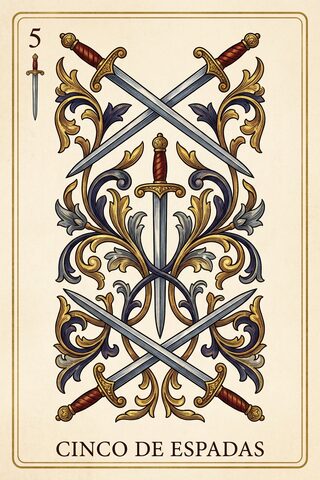
Cinco de Espadas
Did the Cinco de Espadas come up in a reading, or do you want to see what the cards tell you today? Get your free Spanish deck reading with a personalized interpretation.
Deal the Spanish cardsThe Five of Swords is the card of battles that no one wins completely. In the Spanish deck, the five is the number of change and loss, and applied to the suit of conflicts it results in one of the most uncomfortable cards in the pack: arguments that escalate, wounded pride, victories that taste of defeat. Traditional cartomancy reads it as the warning of a confrontation in which, even if you are proved right, you may leave behind something more valuable than being right.
Don't panic: this card doesn't condemn, it warns. It appears precisely so that you can see the clash coming and decide, with the cool head the suit of swords always demands, whether that battle is worth fighting or it is wiser to withdraw with your dignity intact.
Meaning of the Five of Swords
It speaks of conflicts where the ego weighs more than the matter in dispute: bitter arguments, foul play, humiliations, people who play dirty to win. Also of losses associated with confrontation —friendships, trust, energy— and that bitter feeling of having won the argument and lost the person.
- Open conflict: tension that erupts into argument or confrontation.
- Pyrrhic victory: winning something that costs more than it is worth.
- Wounded pride: the ego directing decisions that should be made with the head.
- Foul play: someone may be playing dirty; watch out for tricks.
- Loss and change: something breaks, but it leaves space to rearrange everything.
The Five of Swords in love
With a partner, this card portrays arguments where you no longer fight over the original reason but to win: crossed reproaches, words meant to wound, lists of grievances recited from memory. Its warning is clear: in love, whoever wins every argument ends up losing the relationship. It can also point to third parties sowing discord or breakups handled with more resentment than necessary.
If you are single, check whether you drag old battles into new bonds: arriving at a story with your sword drawn usually scares off exactly what you are looking for.
In work and money
The professional field is where this five becomes most literal: rivalries between colleagues, poisoned atmospheres, bosses or partners who take credit for others' work, negotiations where someone plays with marked cards. Don't sign anything without reading it twice and don't share your plans with anyone who hasn't proved worthy of your trust.
With money it warns of losses through disputes: claims, contested debts, expenses arising from a conflict. Sometimes it is more profitable to give a little ground than to win an endless lawsuit.
And if it comes out reversed?
Reversed, the Five of Swords usually announces the end of the conflict: possible reconciliations, prides that finally soften, or the liberating decision to abandon a war that wasn't yours. Its reversed shadow also exists: entrenched resentments that refuse to close. The neighbouring cards will tell which of the two readings prevails.
The advice of the Five of Swords
Before entering the clash, ask yourself the question this card has been posing for centuries: do you want to be right or do you want to be at peace? Choose your battles; withdrawing from the ones not worth it is not cowardice, it is good aim. If the conflict is already upon you and you need to see all its angles, the 5-card Spanish reading will show you what feeds it and how to defuse it. And when the storm passes, remember that the path of the suit continues: in the Six of Swords the crossing toward calmer waters awaits you.
Frequently asked questions about the Cinco de Espadas
¿Qué significa el Cinco de Espadas en la baraja española?
Avisa de conflictos donde el ego pesa más que el asunto en disputa: discusiones que escalan, malas artes y victorias que salen caras. El cinco es número de pérdida y cambio, así que señala enfrentamientos con coste, pero también la opción de evitarlos.
¿El Cinco de Espadas es una carta mala?
Es una de las cartas de aviso del mazo: anuncia tensión, disputas y posibles pérdidas asociadas al conflicto. Pero no condena: aparece justo para que veas venir el choque y decidas si esa batalla merece la pena o es más sabio retirarse a tiempo.
¿Qué significa el Cinco de Espadas en el amor?
Retrata discusiones de pareja donde ya solo se pelea por ganar: reproches, palabras hirientes y orgullos enfrentados. Su aviso es que quien gana todas las discusiones acaba perdiendo la relación. También puede señalar rencores o terceros que meten cizaña.
¿Qué hago si me sale el Cinco de Espadas en una tirada?
Tómalo como una señal para elegir tus batallas: pregúntate si prefieres tener razón o estar en paz, protege tus planes de quien juega sucio y no firmes nada sin leerlo bien. Las cartas que lo rodean indican de dónde viene el conflicto y cómo desactivarlo.